
From the Beacon…
A Clearer View of the Cosmos

This website is mostly about a lot of life-changing, world-changing information that streamed to Earth late last century through the computers, TVs, radios, phones, and other electronic devices of researchers involved in ITC, or instrumental transcommunication—the use of modern equipment to get in touch with the worlds of spirit.
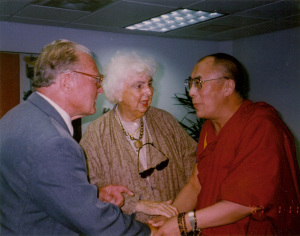
Those 20th Century communication bridges between Earth and spirit were facilitated and protected by finer spiritual beings like the fellow on the left, until the bridges disappeared around the year 2000.
I was very lucky to become one of those ITC researchers in 1992. We established an international network (INIT) in 1995, and my main job was to document everything that was happening as best I could.
Note: I developed this website with my computer, and the formatting seems to work best when viewing the site with a computer, rather than with a mobile device like a cell phone.
Or, if an Android mobile device is your only option, select “Desktop Site” from the drop-down menu under the three dots at the top right on the mobile screen. (On Apple iphones, you may need to download the “Desktop Browser” app, which you might also find useful for general purposes.)
.
Revelations and Cosmic Truths: Introduction (2026)
I hope these messages change your life the way they’ve totally changed mine. Our INIT group received this information from finer spirit beings a quarter-century ago, but it’s never before been gathered together in one place, boiled down to key bits of timeless wisdom, and explained in clear, simple terms. The result is a transformational understanding of the timeless, superimposed cosmos—the all-that-is—and how we fit into it.
Revelations and Cosmic Truths: Introduction
Revelations 1: Our Ancient Past
Revelations 2: Our Cosmic View: Fact and Fancy
Revelations 3: Dramas of Living on Earth
Revelations 4: Dramas of Dying on Earth
Revelations 5: After We Die, the Basics
Revelations 6: When Spirits Intervene
Revelations 7: Good ITC and a Good Life: Same Principles
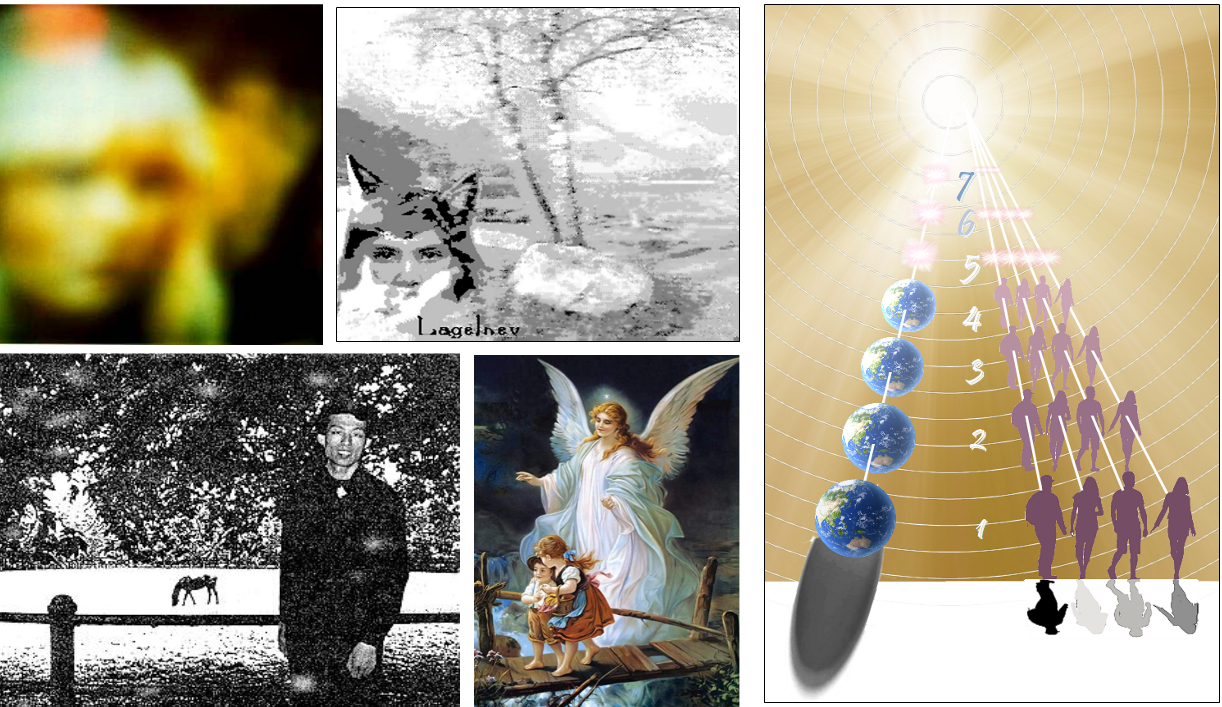
Right: How our spirit friends envision the infinitely vast and complex, superimposed cosmos, divided into seven arbitrary levels for easier understanding. Earth is at level 1. Our afterlife paradise is at level 3. The source (a.k.a. God, Braham, Allah, the universal life force, the all-that-is…) is beyond level 7, at the center of everything.
The first three pictures were delivered to our world through ITC systems of our INIT group in the 1990s.
.
Exploring Eternity in Small Steps— “Minis” (2025)
Prepare for a tour through the all-that-is, taken one small step at a time. Each short article helps to put our fleeting Earth experiences into perspective with omnipotent forces and timeless principles that give shape, vitality, and purpose to the countless worlds and universes flourishing throughout the superimposed, many-dimensional cosmos.
(Italicized listings like #4, #7, and #17 are self-care articles.)
Part One: The Heaven-Earth Dichotomy
01 The Cosmos —— 02 Money ——
03 AI —— 04 Flexing Exercises ——
05 Divisive Politics —— 06 Apocalypse ——
07 Inner Peace —— 08 Contact Field ——
09 ITC Bridge ——
Part Two: “The Seven” Protectors / Gatekeepers
10 Who They Are —— 11 What They Want ——
12 When They Intervene —— 13 Where They Live ——
14 Why They Support Earth —— 15 Ways They Support Earth ——
16 Their Wish for a Closer Rapport with Us
Part Three: Optimizing a Lifetime
17 Stretching Exercises —— 18 Preparing for the Last Day ——
19 Taming the Savage —— 20 Polishing Passion to Perfection
21 Loving the World Through Hateful Times
22 Helping Battered Souls Find Peace and Purpose
23 Exploring the Cosmos with the Sixth Sense
24 Fixing the Family in a Broken World
Part Four: All About the Afterlife
25 Afterlife Overview —— 26 Who Lives Where
27 Dreams: Snapshots of the Afterlife
28 What They Want Us to Know About Eden
29 Personal Realities at Level 3 —— 30 Social Realities at Level 3
31 Planetary Realities at Level 3 —— 32 Cosmic Realities at Level 3
Part Five: Just Imagine!
33 Best Version of Ourselves —— 34 Best Version our Families
35 Best Version of our Countries —— 36 Best Version of our Planet

.
Out There (2024-2025)
The articles in this series try to make sense of the vast, eternal cosmos, with its countless superimposed dimensions, universes, and worlds, in ways we can easily understand.
01 Handling Drama (whether it’s a broken chair or a broken world)
02 Journey from the Center of the Cosmos
03 Flourishing in the Lightest and Darkest of Times
04 Those Lights Over New Jersey? Drones, UAVs, UFOs?…
05 Ethereals, Extraterrestrials, the Source, and the Shadow
06 God on Earth and God in Spirit Are Worlds Apart

.
Worlds Apart (a collection)… (2011-2024)
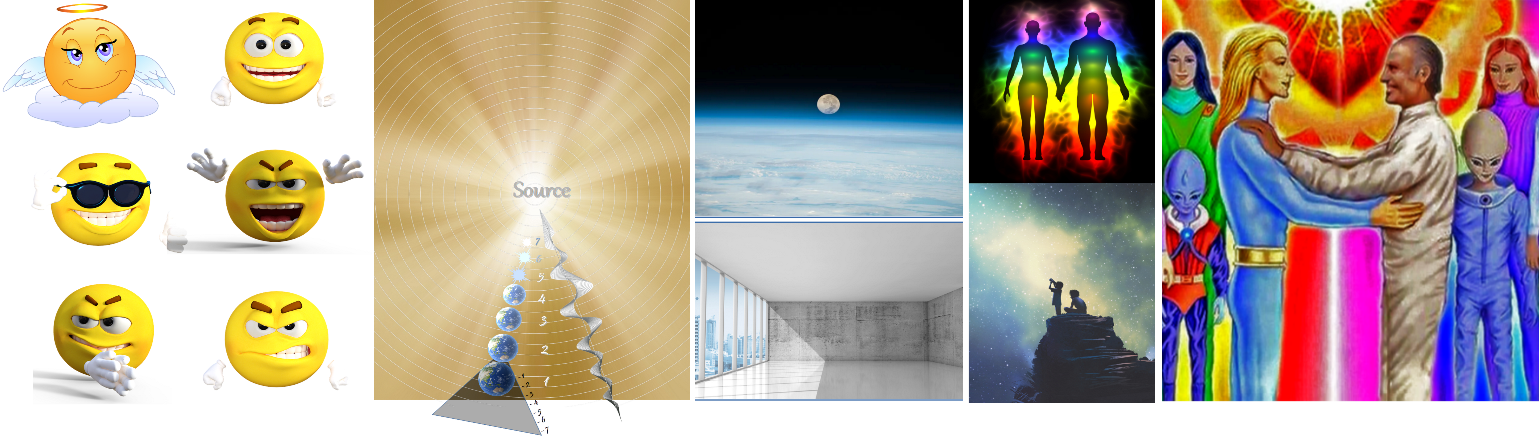
Earth is apparently unique in many ways. Here are some of the differences between our world and the rest of the cosmos.
God on Earth and in Spirit….. Worlds Apart
Physics on Earth and in Spirit Are Worlds Apart
Energies on Earth and in Spirit Are Worlds Apart
Space and Time on Earth and in Spirit Are Worlds Apart
Relationships on Earth and in Spirit Are Worlds Apart
Freedoms on Earth and in Spirit Are Worlds Apart
Conversations on Earth and in Spirit Are Worlds Apart
.
ITC – Instrumental Transcommunication… (2023-2024)
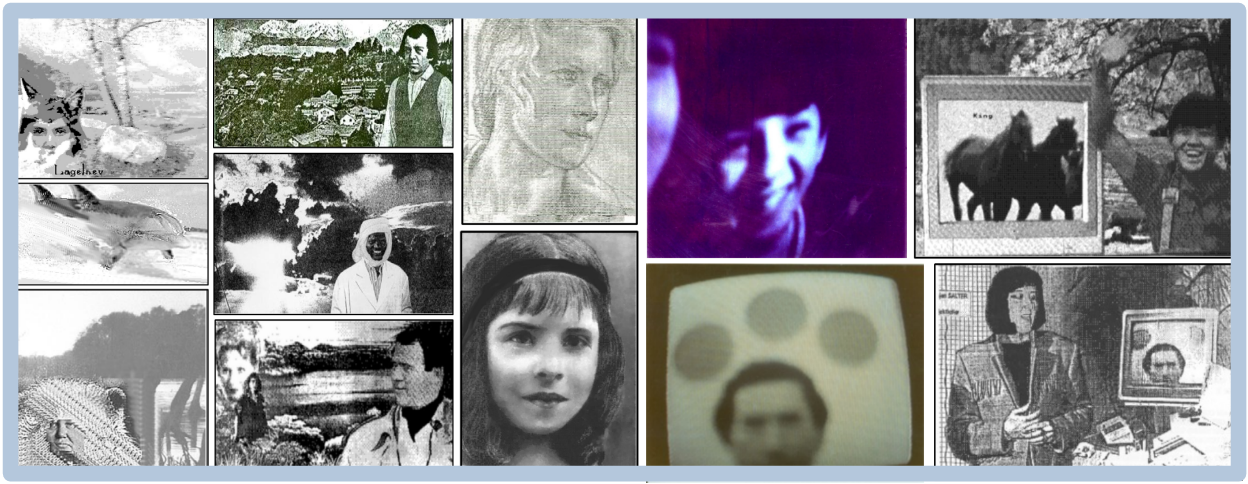
ITC, or Instrumental Transcommunication, is a technique for getting in touch with the other side through modern technologies, especially as experienced by our INIT group in the late 1990s.
00 Chatting with Finer Worlds Through Technology —— 01 Conversations on Earth and in Spirit Are Worlds Apart —— 02 Breathtaking Spirit Contacts Through Technology ——
03 Computer Pictures from Spirits (A) ——
04 Computer Letters and Reports from Spirits (B) ——
05 Spirit Messages on Answering Machines (C) ——
06 Spirit Phone Calls (D) ——
07 Spirits Talking Through Radios (E) ——
08 Spirits on TV (F) ——
09 Spirit Faces and Other Widespread Contacts —— 10 ITC in Perspective ——
11 INIT’s ‘Death by a Thousand Cuts’—— X Wrap Up
.
Light… (2023)
Life-energy from the source (God, Allah, Brahman…) is often called “Light.” It fills the cosmos with vitality and goodness. Here’s how we get a glimpse of it on Earth, and how we can help it stream into our world and our lives with greater luster.
00 Introduction: Into the Light —— 01 Energies on Earth and in Spirit Are Worlds Apart —— 02 Out of Suffering —— 03 We (and Driverless Cars) Navigate with Morals —— 04 Mind-Body-Spirit in Harmony —— 05 Miracles and Siddhis (Divine Intercessions) —— X Wrap Up

.
Terra… (2022)
Living things on Terra, or Earth, sometimes hurt each other intentionally, take stuff from each other, squabble to dominate, and do other things that are at odds with the cosmos. These defiant behaviors deflect much of the Light from the source, something humanity has been struggling with for thousands of years.
00 A World Askew —— 01 The Source, We Can Only Imagine —— 02 Symbiotic Relationships Across the Cosmos —— 03 Money Money Money, How It Mimics Life-Energy —— 04 How Our Material Universe Came To Be —— 05 Emotions, When Body and Spirit Blend or Bristle —— 06 How Pure Love Gets Earthy —— 07 Ethics Shape Us, Morals Let Us Shine —— 08 Physics on Earth and in Spirit Are Worlds Apart —— 09 Our Blissful Spirit’s Wild Ride on Terra —— X Wrap Up

.
Philosophy… (2020-2021)
A philosophical approach to Earth living….
01 Introduction —— 02 Why do we lie and cheat? —— 03 What’s Humor? Laughter? —— 04 Government: Society’s “Alpha” —— 05 Mysteries of Ancient Wisdom —— 06 Free Will vs Fate —— 07 Faith vs Evidence —— 08 Our Long History with Extraterrestrials —— 09 Sensitive Souls on Earth —— 10 The Source, the “Whole Shebang” —— 11 Life-Energy by Any Other Name —— 12 Mystics: Why People Suffer —— 13 Apocalypse / Revelation —— 14 Space and Time on Earth and in Spirit: Worlds Apart —— X Wrap Up
Philosophy Sidebar: Taste of the Apocalypse

.
Worlds Within Worlds… (2019-2020)
Exploring the dichotomy of living rollercoaster physical lives with our rich and refined spiritual heritage… and approaching the dichotomy from various perspectives.
00 Introduction —— 01 Our connection to the source —— 02 Where the body meets the spirit —— 03 Things to do in the afterlife —— 04 Ancient human timeline —— 05 Rise and fall of an epoch —— 06 Growing up in the second epoch —— 07 A little formula that pulls everything together —— 08 The creation of heaven and hell —— 09 Welcoming the life force —— 10-11 Managing life —— 12 How life-energy powers ITC —— 13 Portals —— 14 Fearless —— 15 Science preps for a quantum leap —— 16 Timeless principles of religion —— 17 End time in perspective —— 18 Peace and joy in a brutal world —— 19 Spirit contacts and the public —— 20 Good and evil in a nutshell —— 21 Spirit and money —— 22 It’s between you and God —— 23 Light and dark levels of reality —— 24 How life-energy works and feels —— 25 Energy healing and spiritual healing —— 26 ITC spirit collaborators —— 27 What are dreams? —— 28 What are emotions —— 29 What is wealth… abundance? —— 30 What is symbiosis? —— 31 What’s happiness (in 4 words)? —— 32 What are morals, ethics, and laws? —— 33 Why all the divisiveness? —— 34 Sex, romance, relationships —— 35 Extraterrestrials and “The Project” —— 36 Freedom on Earth and in spirit: worlds apart —— X Wrap Up

.
The Human Story… (2011-2012)
Speculations (based on good evidence) on how we physical humans came to be, how we’re integrated with our spiritual heritage, and where we seem to be headed.
01 From the Source of All-That-Is —— 02 Physical Life and Spiritual Life —— 03 An Ancient Timeline —— 04 The Edenites and Their Descendants —— 05 The Seven Ethereals —— 06 The Afterlife Eden —— 07-10 Afterlife Experiences of Jules Verne, Arthur Moos, Richard Francis Burton, and Anne Guigne —— 11 Afterlife Wrap-Up —— 12 Atlantis and the First Epoch —— 13 Thoth the Atlantean —— 14 Modern Civilization Sprouted from Ancient Pyramids —— 15 Hands that Caress and Strangle the World —— 16 End of Story, End of Times —— 17 Relationships on Earth and in Spirit: Worlds Apart —— X Wrap Up

.
There’s lots other useful information scattered around the website too, especially the…
“ITC Gems” (directly below), a repository of the more profound and puzzling contacts we INIT members received from our spirit friends (texts, pictures, audio and video clips, and more),
- “Life on the Other Side” articles, where our brilliant spirit friends describe their lives and their world, and the
Contact! journals, where I reported the contacts as they were happening in the 1990s.
ITC Gems
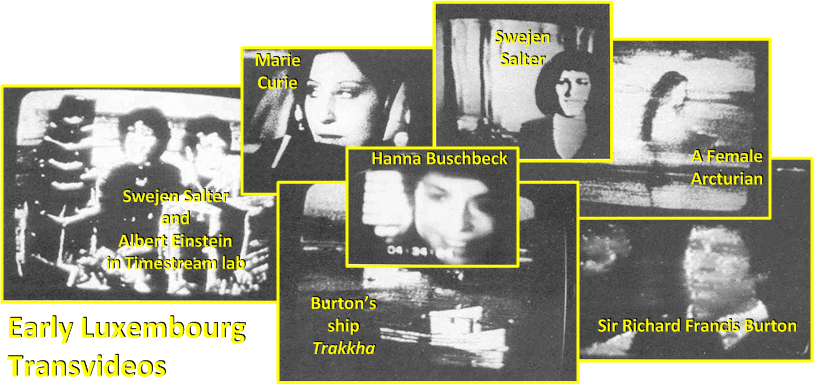
Reading this extensive series provides a better understanding of our multidimensional / spiritual nature and what happens to us after we die. The articles include wisdom delivered through the equipment of ITC researchers here on Earth… mostly from “The Seven” ethereals who introduced themselves to us (INIT… International Network for Instrumental Transcommunication) as “gatekeepers” between Earth and the spirit worlds. The information came through faxes, phones, radios, computers… from spiritual realms virtually unfiltered, offering the cleanest possible glimpse into the Beyond. (Gem #13 is a good place to start exploring this series of articles.)
Note: I’m confident that the information in this collection of articles is highly reliable, as it came through INIT’s stable ITC system before the year 2000.
1 How we affect the spirit worlds 2 Reliable look in-beyond 3 Phone chat with an invisible friend 4 Murdered child is found and healed 5 How thoughts create reality 6 Strangeness of material reality 7 More about Planet Varid 8 Reincarnation from ethereal eyes 9 Convincing a skeptical public 10 How some people reincarnate 11 The end of reincarnation 12 Friedrich Juergenson makes contact 13 How the Luxembourg miracle began 14 How humans, spirits, and angels see God 15 The nature of spirit 16 Life on the other side 17 Avoiding dark forces in spirit work 18 How angel pictures are delivered to Earth 19 More afterlife descriptions 20 Timestream and othe spirit groups 21 Time and space in the astral realm 22 How things work in ITC 23 Power of thought 24 Reliable facts about the afterlife 25 Ethereal beings 1 26 Ethereal beings 2 27 Technical ITC 28 Transimages 29 More transimages 30 Technical ITC: Transvideo 31 Technical ITC conclusions 32 The second epoch 33 Parallel worlds and shadow worlds 34 Medicine and the human spirit 35 Atlantis (Science may be closing in) 36 Humans came from Eden 37 Secrets of life and afterlife 38 Perspective from Beyond 39 Inside story of the afterlife 40 More about the early Luxembourg experiments. 41 Dangers of Anti-Energy Experiments.
.
Life on the other side (…the spirit realms)
Vivid descriptions of the afterlife from those who live there.
(Note: most of the information in this collection of articles is derived from ITC contacts that I consider to be accurate and reliable.)
Things to do in the afterlife – Life on the mid-astral planes – Reliable look in-beyond – Fantastic arrivals into the worlds of spirit – Strangeness of material reality – More about Planet Varid – Reincarnation from ethereal eyes – Convincing a skeptical public – How some people reincarnate – The end of reincarnation – Life on the other side – More afterlife descriptions – Timestream and othe spirit groups – Transimages – More transimages – Transvideo – Perspective from Beyond – The afterlife of Jules Verne – The afterlife of Sir Richard Francis Burton – The afterlife of Arthur Moos – ITC or magic or God… what spiritual path is for me – Why the similarities to PJ Farmer’s Riverworld Books? – Illusion of time as experienced in-beyond – Native American spirit communities – Afterlife update 2018 –
Special series on the subject:
Maggy’s father crosses over… (the afterlife experiences of Albert Fischbach)
… then reports from inside Timestream –
… then meets an Ice Age man at the big, white house… –
…and explores the spirit worlds with Richard Francis Burton….
Light Afterlife Adventures – This is an article called “Our Blissful Spirit’s Wild Ride on Terra.” It has the first-hand testimonials of people who’ve died and gotten settled into light, beautiful worlds… as most of us do. And it describes the blissful cosmic feeling we usually have once we’re free of the physical body and move to finer realms closer to the source.

Dark Afterlife Adventures – summary of a classic, century-old book, Wanderer In the Spirit Land, by Franchezzo, with commentary. This series offers vivid descriptions of the dark or negative spirit realms around the Earth… a subject that is mostly avoided in the ITC contacts explored on this site. So, if you want to know about “hell,” this is a good place to start.
(Note: The information in this series of articles isn’t substantiated by ITC contacts but it explores important afterlife subjects that our ITC contacts avoided, so readers might want to consider these articles to be more speculative than the ITC results described elsewhere on this site. Franchezzo’s information feels pretty credible to me, but readers should decide if it resonates with them.)
…1 Lost in the dark (chapters 1-5).
…2 Serving the Brotherhood (chapters 6-9).
…3 Struggling out of darkness into light (chapters 10-14).
…4 Preparing for rescue work (chapters 15-17).
…5 Rescue mission to hell (chapters 18-21).
…6 More hell (chapters 22-24).
…7 Old generals never die (chapters 25-26).
…8 Weary homecoming (chapter 27).
…9 Free at last (chapters 28-31).
..10 Journey’s end at the threshold to heaven (Chapters 32-34).
..11 Review and analysis of the book.
.
The Human Story (Second Thoughts)
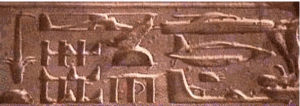
The Human Story collection of articles left some unanswered questions that I tried to address later:
Related articles:
Our cataclysmic beginnings and their impact on modern living —
Asteroids pummeled Earth for 2 billion years —
Mysteries of Eden —
Mysteries solved! —
As disasters worsen, what’s preventable, what’s not?… —
Our ancient human timeline (Worlds Within Worlds, part 4) —
Unanswered questions and best guesses (first in a series of articles) —
1. How did life on Earth survive the ancient cataclysm? —
2. Lives destroyed, lives preserved during the fall of Eden —
3. How an ITC bridge really works —
4. Why ITC bridges closed down around the year 2000 —
5. Why INIT’s ITC bridge was to astral Eden, not astral Earth —
6. Why ‘the veil’ opens and closes —
7. Where the Edenites came from, before Eden —
8. Why Eden has three suns —
9. How parallel universes correlate with spirit realms —
10. Who gets future ITC bridges —
11. Do asteroids have spirit bodies —
.
Humanity as Seen Through Ethereal Eyes

Analysis of a 1996 ITC contact via telephone… what might be the most dramatic and important message ever received on our planet from beyond, more dramatic even than the “handwriting on the wall” incident in ancient Babylon, and of greater depth than the messages received through the Ark of the Covenant in Biblical times. It’s a message from “The Seven” ethereals, or “Rainbow People.”
.
How did “The Seven” Ethereals Influence Human History?
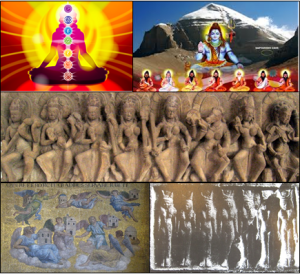
Speculation on how the seven ethereal “gatekeepers” who managed the afterlife bridge for INIT (1995-2000) might well have been monitoring and guiding humanity’s development since ancient times.
1) Lots of 7s down through the ages
2) The 7 Hathors of Ancient Egypt
3) 7s of Judeo-Christianity: Archangels, lamps of fire, churches of Asia…
4) 7s of the Far East: Rishis, Matrikas, Divine Women, chakras…
5) The 7 Rays
6) 7 heavens –
.
ITC Tips
After a quarter-century of ITC research, I’m pulling together some of the main principles and basic considerations that might provide some ideas for people getting involved in ITC (and other spirit-related activities).
1: Keep It Clean 2: Spiritual Research or Paranormal Research?
3: Find a Predisposition for ITC 4: What Sort of Spirits To Expect –
Three prerequisites for an ITC bridge – Pay attention to dreams –
.
The Coming Golden Age of ITC
1) How it could unfold… resonance
2) What can go wrong… human shortcomings
3) Preparing for it… reawakening
4) The next big breakthrough
5) ITC and the End Time
6) Dawn of a new science, courtesy of ITC
Related articles:
– An ITC group doesn’t have to be expensive
– An ITC group today could accommodate many languages
– A ‘we’re all doing the best we can‘ attitude
– Three technologies that make the Golden Age of ITC possible
– A new website for ITC groups
– If this blog were part of an ITC group…
.
What ITC Groups Could Learn From Others
Getting a better understanding of the other-worldly principles that apply to ITC groups by comparing them to more familiar, worldly groups.
1) Introduction 2) Prologue 3) Saturday Night Live (TV comedy revue)
4) The United Nations 5) Spy agencies. 6) Disney. 7) Religions
8) The Ancients… ancient intelligence… Edenites 4B years ago… ancient nukes…
9) The INIT experience… mission… personalities… management… funding…
.
Bridge Building
This series explores some of the specific tools and techniques that an ITC group could use to sustain resonance or harmony, which is probably the most important component or quality of an ITC bridge. These articles are being developed in conjunction with my worlditcnet website template for ITC groups (both the public site and the private site). Between the two (this series and the worlditcnet sites), and with the help of readers of this site, I’m trying to determine what will really work to establish exceptional ITC portals between this world and competent spirit groups at the third level, or mid-astral realm. The series is called “resonance experiments,” and the actual experimenting unfolds in the comments section after each article.
- Blogs and chatrooms – 2. An afterlife map or model –
3. Three Prequisites for an ITC Bridge – 4. Clear Mission Statement –
.
Way of the Shaman

These articles are about those individuals who have certain qualities that let them serve as a living bridge or conduit between the material and spiritual worlds… and have attracted a spirit team to get useful results in healing, spirit photography, and other pursuits.
1) Bridging Heaven and Earth
2) The Adventures of George Meek and Bill O’Neil
3) Northern Miracles
4) Into the Dark
5) Spiritual Coherence, Trauma, and Shamanism
6) The Shaman Carly
.
Faces in the Mist
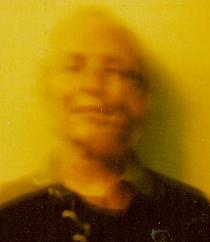
These articles take a close look at the strange Polaroid pictures I took over the years, capturing the clear faces of spirits superimposed over the faces of the human subjects. It involved a special technique and technology, as explained in the series. Chapter 2 has some especially good examples of the spirit faces.
1. Colorado Springs
2. New York
3. Amazement in the basement
4. Deafening silence
5. Visits from beyond
6. Afterword about fear
.
In Your Dreams
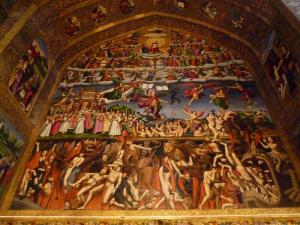
This interesting collection of articles explores dreams… our nightly excursions into the spirit realms. While our conscious mind and physical body are asleep, our astral mind and body are off enjoying various adventures, a glimpse of which we often recall if we awaken right after the dream. As the conscious mind kicks in, the dream fades away into our astral (subconscious) memories. But if we can relax our mind back into a dream or “alpha” state without falling back asleep, many of the dream’s details will return.
The true meaning of dreams – Why Hell is depicted down below –
Life-swapping: The amazing story and prophecies of Paul Dienach –
Time-hopping: The amazing story of Ken Webster –
Packing light for the final journey – Sleep paralysis / night terrors –
Last lucid moment before death – Are dreams more memorable as we age? –
Dreams can determine coherence of an ITC contact field –
.
Politics and the Human Spirit
These articles look at politics from the perspectives of leading thinkers from around the world… and beyond. We examine the world around us, the world inside us, and the worlds in-beyond of us… that is, the realms of spirit superimposed over our material world in other dimensions. (A larger collection of political articles can be found on my counterpart website, Noble Savage World.)
Politics & the human spirit – Spirit of Society – The carnal line between noble and savage – Embrace the divine; it’s where we shine – Human spirituality and politics – Capital punishment & the human spirit – Inappropriate behavior or inappropriate world? –
.
What I Learned from ITC
Several articles on what ITC research taught me.
1 Being sensitive in a harsh world – 2 Controlling emotions – 3 Leaving the family of man – 4 How spirits navigate time and space – 5 Hardships heighten the human experience – 6 To establish a bridge – 7 The illusion of time – 8 Life on the mid-astral plane, or third level – What I learned from ITC about being human – Will I continue ITC research after I die? –
.
Science and the Human Spirit
Several articles about modern science and the challenges it faces in trying to reconcile spiritual reality through its neo-Newtonian worldview. (A larger collection of science articles can be found on my counterpart website, Noble Savage World.)
Measuring maya — Foreign-accent syndrome — Science Will Soon Explore Beyond Duality — Asteroids pummeled Earth for 2 billion years — Exoplanets and the prospect we’re not alone! — Mysteries of Eden — Combat killing and the human spirit — Aurora theater tragedy — News in perspective — A life and afterlife debate — Pseudoscience and pseudo-reality — Learning from the ancients — Modern day epicycles — More modern epicycles: science and NDEs — Global warming and shifting poles — Hollow Earth theory — Our cataclysmic beginnings —
.
Health and Well-Being
Personal development… physical, emotional, and spiritual growth… including articles on:
Meditation & Prayer:
Heart meditation –
Meditation; ticket to paradise –
Prayer; another ticket –
Tapping on Heaven’s door –
Concentrate, Contemplate, Meditate (Sai Baba) – How to pray, and why – Two nice mantras –
Physical Exercise:
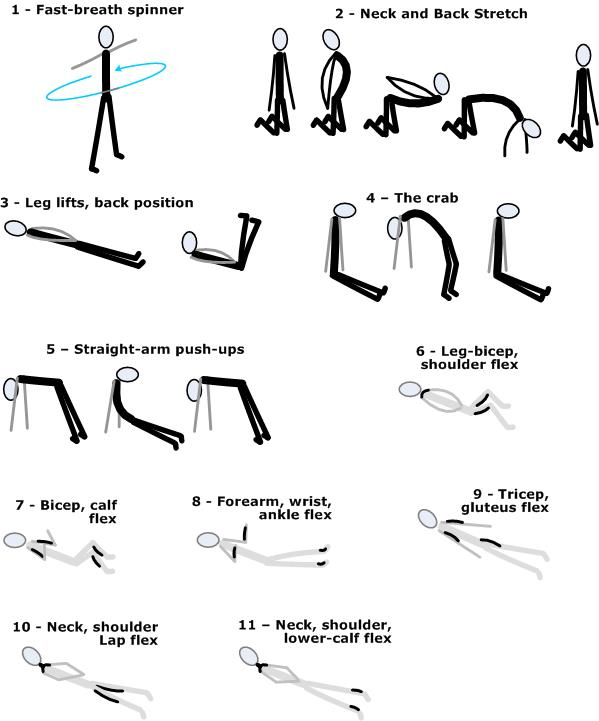
Some great exercises –
Mantric exercises
Spiritual Growth:
Cleansing the cluttered mind – Embrace the divine; it’s where we shine –
Go to the light – Healing and the human spirit –
Love and good will… but what about trust? –
The carnal line between noble and savage – An apology can lift the spirit – Releasing meddlesome spirits –
Go with God, take your bike, don’t hit a bus, but if you do, go with God –
Should humanity really know about the afterlife? –
Nonspiritual people can find a spiritual path –
What do you want to be when you die? – Dear, not fear: Sai Baba –
Purpose of a lifetime – Reincarnation and the tree of life –
Self-Awareness:
Are you an extrovert or an introvert? – Know Heaven – Know thyself –
Addiction & Mental Illness:
Nonfunctioning alcoholism – From Darkness to Light with 10 Easy Words –
Addiction – Mental illness: barriers lost – Sleep paralysis –
Addiction and spiritual blinders
Medicine
Medicine and the human spirit – Understanding the heart –
Last lucid moments before death –
Other Subjects:
What shapes children the most as they grow up? –
Blowing away emotional blocks with breathwork –
Troubled spirits: fight ’em and join ’em… or rise above –
.
My 45-Minute Video About ITC and the Afterlife
I stopped giving seminars and presentations years ago because I wasn’t very good at public speaking. Then I realized I could put together everything I’ve learned about the afterlife into a nice powerpoint presentation that could be played at conferences. This one (above) is the most recent one, presented in Montreal in 2018, for IIIHS.
.
Nice Afterlife Songs (…youtube)
Not Just In Your Dreams / The Other Side –
See / Glory of the Host –
.
Afterlife Films
Movies, TV shows, and reviews of movies about the afterlife.
Nosso Lar (Our Home) – Chico Xavier – Calling Earth –
The Afterlife Investigations – Life After Death Project –
Twilight, Camille, and Coraline –
TV shows about Luxembourg and German ITC (1980) –
.
Paranormal Video Clips from Europe – (…youtube)
Eight amazing images delivered by spirit groups to the TV sets of ITC researchers in the 1980s…
.
News Summaries
Periodic roundups of national and international news, put into perspective of our spiritual and noble-savage heritage.
- June 2018 (Uncle Sam’s Sharp Right Political Turn)
- December 2017 (Inappropriate behavior)
- June 2017 (More from our ancient past)
- December 2016 Part 1 (Transformation and treason)
– Part 2 (Sliding toward a dark age behind big oil’s trump card)
– Part 3 (You’re a mean one, Uncle Sam)
– Part 4 (America in the grips of the Dark Triad) - June 2016
- December 2015
- June 2015 Part 1 . . . (Part 2) . . . (Part 3)
- December 2014
- June 2014
- March 2014
- December 2013
- February 2012
.
If you have trouble finding an article from this index, you might try the search window near the top of this page (or any other page on the site).
Mark Macy
itcmark@gmail.com

 Macy Afterlife: The Beacon

Mark, do you still have the clip of the camera rolling past a forest area?
Wow, George, what a surprise.
You’re probably referring to an obscure little video clip, one of several that the Harsch-Fischbach couple in Luxembourg received… in 1987, I think… when their spirit group (Timestream) with the help of The Seven ethereals was trying to open an ITC bridge with the couple… with some mind-boggling results… one being that little clip that I think you’re mentioning, shot by a spirit-world movie camera moving smoothly through a spirit-world (astral) forest.
I’m not sure how you heard about that clip, or saw it, but I just looked through my youtube channel…
http://www.youtube.com/user/worlditc
… and realized that that particular clip is missing from the collection of similar transvideo clips.
I think I have it around somewhere, and I’ll see if I can get it posted there on youtube, along with the others.
Thanks for the heads-up.
Mark
I actually have a still shot of that video clip that I was using as wallpaper for awhile. I saw it on one of your other sites. I believe it was worlditc.org but not entirely sure.
Mark, did you ever find that clip?
Hi George,
Not yet. I think it might be on my older computer.
But I’ve been busy lately and haven’t gotten around to searching.
Hope to soon………..
Mark
George, it took some time, but I got around to adding the landscape clip. Mark
Mark,
This really is pretty incredible.
I must say that it is very similar to an earthly-landscape. Was it Swejen that recorded this? When I study the landscape, I begin to wonder if this might be a world that is located a bit closer to the 2nd level, rather than the 3rd level. Did Timestream provide any comments on this particular recording?
I hope our friends at Timestream really do realize just how much they are appreciated by some here on Earth.
Ricky
Mark, Thank you so much! You made my day. You are a true angel my friend and just in case no one has told you that the love you today well…. I do! : )
You’re welcome, George.
Warm wishes to you as well!
Mark
Hi Ricky,
I’m not sure if that video clip came through in 1986 or 1987… the year Swejen died on her home world and got settled in at Timestream.
I suspect it’s the third level, but the poor quality black-n-white video capture makes it look darker than it probably is.
I’m sure Timestream and our other spirit groups follow our feelings closely when it comes to ITC. I suspect they appreciate your interest and your comments a lot.
Mark
P.S Mark, May I download this for my own?
Sure, George, that’s fine… since it’s not for profit
Mark
Mark – I love your book Spirit Faces and it has inspired my own research and work. I would like to reference your work in my next book. Please contact me to discuss. 😉
Hi Diana,
Glad to be in touch with a kindred spirit.
I’ve sent you a reply email for follow-up with books and references….
All the best!
Mark
Hello Mark, I’m so grateful for all ITC work you and your friends have done. I’m following you for about 7 months now. Now I found out that there is a lot of scientific work done in the field of Quantum energy and Qantum consciousness, Dr. Swejen Salters field 😉 But, there is one research institute, the Anderson Institute (http://www.andersoninstitute.com/default.html) involved in time travel. I don’t know, but I felt alarmed since I know about Swejens Salters destiny in such experiments. What do you think, what do other researchers think? What does Swejen think? Please answer me. Love and Light from Germany – Nadin 🙂
Thanks, Nadin, for the link to the Anderson Institute.
I visited the site and found it to be a lot more credible and orderly than I’d expected.
I’m not too concerned by experiments in time… which we know is an illusion of the material world.
(Hope I’m not wrong in my indifference 🙂 , but it doesn’t feel dangerous to me.)
Swejen and her team on Varid were using a series of vacuum-tube implosions to create a perfect vacuum, from which to find the coexistence of energy and anti-energy… and to manufacture anti-energy. And that’s what apparently led to the massive destruction in her world.
A closer correlation in our world seems to be our Large Hadron Collider in Cern, which I’m still a little nervous about. Not much happening there since the initial tests… not until next year, when things are expected to ramp up. I plan to watch with some interest.
If you’re interested in that, you can read my two articles on the subject. THe first one includes the contact by Swejen Salter.
Again, thanks for the link to the Anderson Institute and its time travel efforts.
I’ll try to watch that also, as I find it interesting… and who knows, maybe Dr Anderson IS venturing into dangerous territory.
Warm wishes from the States,
Mark
Hello, it’s me again. I also read that they want to create a reactor. OMG!!! Could you also tell Maggy!? Thanks
Hi again, Nadin.
I’m no longer in touch with Maggy, sorry to say.
Mark
Hi Mark,
I just wanted to say that I am fascinated by your work. I just had a question in your ITC contacts did you ever come across any mentions of an active conspiracy waged against humankind to keep them ignorant and the like (by the government or anyone else etc)?
Hi Jason,
There have been no ITC contacts (that I recall) that reveal conspiracies to keep humans in the dark and ignorant. But I’m sure humans are “kept in the dark” about some things, for various reasons, even though ITC contacts haven’t (yet) explained why.
The idea that the US government has secret relations with dense ETs has become deeply ingrained in the culture. When legends become that well-ingrained, usually there’s some truth to them. I don’t have trouble believing that the US government has projects underway with some dense ETs, which they keep secret out of fear and stupidity. (I DEFINITELY believe the US government operates largely out of fear and stupidity, as do most ruling bodies that get to the imperialistic stage.)
Humans are also kept in the dark spiritually, but that’s not any sort of worldly conspiracy. We grow up with spiritual blinders so that we can’t perceive the spiritual activity going on around us. Why? That’s what I’m trying to figure out at the moment, and it’s the subject of the article I plan to post in the next few days. It’ll be called “Origins of Darkness (Crossed Dimensions 6)”
Mark
Mark, the extensiveness of your work in this field is absolutely extraordinary. I’ve heard of much of it including the Tabula Smaragdina or Emerald Tablets, which I heard about through reading Carl Jung’s work extensively. I didn’t know you had done so much and are offering all of it for free! This gives me hope in all the free things I’m offering which people usually roundly reject. Karma, you know! Cheers, Mark, and congratulations on the extensive work you’re offering to the world it is a greatl contribution!
Thanks Avataress,
It’s always uplifting… hearing from a kindred spirit.
Mark
Hi Mark, I have been very interested in the ITC group and the concept of life after death ever since my dear Dad passed away 6 years ago…Now I’m reading about it again as my Dad’s little dog is on her way out…I had read something about loved ones in another realm being near you when you die, but can’t find the reference now.
It would help a lot to know that my Dad might be there for his little dog Mollie as she leaves our world.
Many thanks for your time,
Charlie (Eliz.) Holtermann
Hi Charlie,
Yes, there have been reports of people and their pets reconnecting on the other side.
The most interesting one for me was in a contact by Scott Joplin (the ragtime piano player) through the telephone of Maggy Harsch-Fischbach of Luxembourg.
There’s a link below to an article on this site that has an excerpt from that contact. First, though, a little background:
Jeannette Meek died in 1990 and befriended Scott Joplin on the other side. Jeannette Meek was often accompanied by a small scottish terrier named “Terry,” which ran around by her feet on the other side.
When Scott Joplin made his ITC contact with the help of Timestream spirit group, there was also present (in spirit) a German fellow named Otto Schwickerath, who in lifetime had been an acquaintance with both George and Jeannette Meek, and with Maggy and Jules Harsch-Fischbach. At the time of the contact, Hilde Schwickerath was visiting Maggy. Hilde was the (still living on Earth) wife of Otto. In earlier years, the Schwickerath couple had a dog named Kucki, who had died before Otto died. Now, at the time of the contact, Kucki was also present on the spirit side, with Otto and Scott and the rest of the Timestream team.
Long story short, during the contact, both Terry and Kucki are present, and there’s some excited barking coming through from the other side.
You can find a description of the contact, and a link to the phone contact audio, here:
All the best,
Mark
Thank you so, so much Mark…You have laid my worries to rest.
Little Mollie and my Dad were inseparable to the extent that when he died she jumped onto to his bed and fretted, and was affected for a long time.
Please keep up your wonderful work…The more I read the more it makes absolute sense to me.
It’s always heartening to hear that my writing about ITC and afterlife makes good sense. That seems to be my main job in this lifetime. Thanks, Charlie.
Mark
Hi, Mark, I just read the email you sent me to one of my old accounts. I still keep my old accts. online. You sent it last March. Glad to hear that you’re still going strong, and your new website looks great. I’ve been super busy over the past few years–too much going on in my life, but I’m still hanging in there. 🙂 My two wonderful dogs have passed, one of them last August, he was almost seventeen years old His brother had died 2 years earlier. I’ve had a few dreams about the first one that passed, but no dreams at all of the other one. My husband died last April 3rd, and everything seemed so empty to the point where I felt like I just had to have another dog in the house. I bought one of the same breed as my other 2 dogs, an Australian Shepherd. They come in different colors, and there are no two exactly alike. They are born only in the Spring, so I was late deciding to buy one. I phoned around, and a dog breeder said that she had only one male dog left because the buyer changed his mind. You guessed it– the puppy had almost the identical markings of my last dog that died. Not only that, it acts as if it had been with me and in my house forever. He even climbed up the stairs to my bedroom, and really made himself at home. Right now, he’s asleep on my foot under my desk as I type. He’s also amazingly smart…not like most dogs that are complete strangers to your home. Do you think this little dog might have my other dog’s spirit inside of it? It acts as if it’s known me forever, even my son.
Hi Ginger,
Nice hearing from you again.
Sorry about the losses in your life.
I’ve heard a number of cases in which a pet dog dies, and the person gets a new pet dog that seems to come with the mind, memory, personality, and soul of the late pet, as though reincarnated.
In some cases the new pet is a completely different breed of dog.
I don’t recall any contacts from Timestream about the reincarnation of pets, but it makes sense to me and “feels right” to think that the spirit of pets close to us can stay close through reincarnation.
Mark
Hi Mark,
I am taking part in a project with my father in writing a book on ITC in Ireland.
I was hoping you could give me a gross figure of centres and/or people taking part in Instrumental Transcommunication over the recent years? I can’t find any information on this particular topic online and there is little to no knowledge of the phenomenon of ITC here in Ireland.
I hope you can help me with this query and I look forward to hearing from you soon.
Regards,
Peter.
HI Peter,
There are many, many people who experiment seriously or just dabble with voice recorders nowadays, and with digital cameras… hoping for a glimpse or a small voice from the other side.
As far as I know, there is no association in which all or even most of those interested people become members (worlditc has never been an open-membership type of organization), so I don’t think there’s any way to get a reliable census on the number of people involved in EVP.
As far as the more elaborate ITC communications that involve a resonant contact field and facilitation by finer spirits for extended radio and telephone dialogs, clear images through computer and TV… that sort of thing, the number of those experimenters is small. There might have been a dozen or so in the 1990s, mostly in Europe. Maggy Fischbach, Adolf Homes, Marcello Bacci, Hans-Otto Koenig, and maybe a few others.
Today, even that small number seems to have dwindled.
On the other hand, there are some shamanistic men and women who are getting amazing results far beyond your basic EVP, such as this fellow, Robert van den Broeke:
http://www.robbertvandenbroeke.nl/bijzondere-gebeurtenissen/Ontmoeting_met_buitenaardsen_en_achtergebleven_lichaamsdelen
For people like Robbert, “the veil” seems to open up around them and many beings can make their presence known in various ways… spirits, ETs, etc.
I’ve written a few recent articles about shamanism (and many articles about ITC!) on this (macyafterlife) site.
Sorry I can’t give you a more specific number of ITC researchers…
Mark
(I wish you and your father the best of luck with your book project.)
I know this reply is a little late but I’ve just got to say in response to your link Mark, “Thank god for Google Translate!” lol
Hey Mark,
I’m not sure if PayPal put the books I wanted or not, I donated $17 and wanted one of all 4 books and the audio cd.
Could you please sign them? It would mean the world to me! I can’t wait to read them. I’ll make another donation once these get here.
Thanks a lot!
-Chase
Hi Chase,
I got your PayPal donation, and the books shipped today.
You’d put a note with the donation to sign the 4 books, which I did.
markM
Hello Mr. Macy:
I first learned about ITC after you invited me into an online group a while ago. We mostly practiced about resonance … I had many interesting experiences before, during and after I was in the group. I lost contact with members after my Dad got ill in 2011. But I want to share with you something that relates to my Dad before passing. Interesting to see so much research today and how science is so open to the fact of life after death. Dr. Bruce Greyson from the University of Virginia has done studies on a phenomena that describes what has happened to my Dad. They found out more about consciousness when they studied people with brains defects , dementia and Alzheimers, like my dad. They found that it was abnormal for some of them to recover from dementia and interacted with others at a normal level before passing. My father passed on 2012 fully recovered from dementia. There were cases that after an accident had lost most of their brain and were able to reason and had great intelligence, proving that consciousness goes beyond the human brain…
As in my home we continue to have the radio turning on by itself on occasions and continue the resonance with those that even when they have passed on, continue so close to us in our hearts and in our lives.
“Is Consciousness Produced by the Brain?” by Bruce Greyson
Thanks Myrna,
Yes, the fields of science and medicine are slowly opening up to the reality of spirit and afterlife. Wife Regina had me watch a segment of Oprah’s “Super Soul Sunday,” where she was interviewing someone called Eben Alexander, a medical doctor who had a bad case of meningitis that pretty much destroyed his brain. For people in that condition, 98% die, and the other 2% survive in a vegetative state. This guy, though, had some really great afterlife experiences while his brain was dead, and then he healed to talk about them… good proof that consciousness is separate from the brain. I wonder to what degree experiences like that (meaningful afterlife experiences by hardened skeptics) are really choreographed and facilitated by finer beings on the other side. A BIG degree, I suspect. 🙂 Mark
Thanks for the clip Mark
It is so encouraging to see the Scientist community getting in resonance with God’s plan. Showing that life has no end and his power is greater than human comprehension.
Happy to know about you… Peace, Love and light!
Nice to hear from you again, myrna, since our group efforts years ago.
🙂
Hi Mark,
I am a local chapter network leader (LCN) for The Monroe Institute here in Northern Colorado. I was wondering if you’d be interested in coming to one of our meetings and talking to our members. I know they would love to hear what you have to say! Please let me know how I can contact you.
Thanks!
Hi Patricia,
Many thanks for your kind invitation. Sorry to say, I don’t give presentations anymore. Writing is a much easier way for me to communicate what I’ve learned about ITC and the afterlife.
I’m very familiar with the good work at The Monroe Institute, doing workshops with them and co-producing our Bridge to Paradise CD with them… and so it’s good to know there’s someone close to home who’s facilitating Hemi-Sync sessions. When I encounter people around here with an interest in OBEs and guided meditation, I’ll invite them to visit your site…
Thanks again for making contact,
Mark
Hi Mark! I just came here to look for your email, so I could share my discovery of Robbert van den Broeke with you… only to find you’re ahead of me!
Amazing things happening with this man, so exciting! Also funny to be posting this right under comments about TMI, which is across the road from me here :). Have you seen pics of the latest ‘phenom’ around TMI’s big crystal? I’d share one here but can’t put pics in a comment.
If you can’t ID me by this pseudonym, I can PM you if you provide your email address. (Hint: Chicago. 🙂
Hi Whitehawk,
Somehow your comments got onto my site without my noticing, and I apologize for that. So here’s a belated reply.
I agree that Robert van den Broeke’s experiences are really amazing.
No, I’m not aware of TMI’s big crystal and the related phenomena. I’ll do some searching. Thanks for the heads-up.
(For example, on a quick search I found a good article about TMI and its big crystal: Here’s a link…)
I went to your site, and it looks like you cover a lot of good information. Thanks for that also…..
Mark
Mark, I am trying to reach you. I have always been a very spiritual person with many experiences from across the veil (especially after my Mother’s passing). I grieved for a long time after the passing of my kitty, Zoe, of 20 years with me in life. She was the last of my 6 kitties in life. I experienced several sightings of her after she passed. One year later , I found some photos taken from an app on my phone. I have not used the app in several years. I was amazed at the photos I found. I did not take the photos or anyone I know. It had to be from Spirit. They look like the photos on your site!!! One is of me: filmy/misty look on most photos. I can see (not clearly) but images of my passed over kitties in my apt during those months of grief after Zoe passed. Amazing!!! Please contact me if possible . I would love to see what you think of these photos I found! If I hear back from you, I will send you copies and my contact information! Sincerely, M. Louise Jacobs
Thanks Louise. Fascinating.
My email is itcmark@gmail.com.
Looking forward,
Mark
Hi Mark,
There is a doubt…
All this is strangely similar to the plot of Philip Jose Farmer’s Riverworld books. Riverworld was a sci-fi series that was very popular in the 1970s. The hero of the first book was Richard Burton…
Can you explain me why your website worlditc.org ceased to publish new items?.
Thank you for your help!!!
Hi Paddy,
Thanks for the comments. I’ve addressed those Riverworld issues in a couple of places, but they’re not so easy to find.
I should probably write an article on this site so it’s more easily searchable.
Meanwhile, here’s some material about Farmer’s materials:
https://macyafterlife.files.wordpress.com/2022/03/c9702.pdf (see page 12)
https://macyafterlife.com/2015/04/12/way-of-the-shaman-1/ (see the comments section at the end)
About the worlditc.org website: My colleague Rolf Ehrhardt and I (especially Rolf) worked tirelessly to gather up all the good ITC documentation that we could find ‘out there’ and we published it on our site.
There haven’t been many major breakthroughs since the work of O’Neil, Schreiber, Bacci, Koenig, Fischbach, Homes, and the other prolific ITC researchers, especially those in Europe, so it just worked out that we’ve let the worlditc.org site rest as major repository of information.
Rolf also has his vast rodiehr website that he continues to develop.
And I have this macyafterlife website where I try to explore more deeply into the inner workings of ITC… how various spiritual principles and worldly principles have to come together to allow the contact bridge to open up.
I also have my noblesavageword website where I can talk about more worldly things that have always interested me.
Mark
Lately I’ve been taking pictures of myself and symbols cover my face, and sometimes my face don’t even show up… would like some insight on it..please
Hi Kim,
Of course I’d have to see some of those pictures before I could even guess.
If you’re interested, you could attach some to an email, and send to:
itcmark@gmail.com
MarkM
Receiving this comment, I went to mysolace in hopes of finding an open means of expressing our afterlife wishes, karmic concerns, and maybe a way to reconnect with those on Earth we’ve left behind.
Instead I found a typical, social network site with a place to put your dying wishes.
Something may evolve from this, but for now…
Mark
HI Mark I would like you to see a photo my sister took on her phone last night we gathered for my daughter’s birthday, there is an image over my sisters face with a darkened cloud. The eye looks like my brother’s who passed away in October of cancer. It’s interesting to say the least and hope filled since we are a very faith filled family…
Thank you!
Hi Paula,
Thanks for contacting me.
I’ve looked at that picture that you emailed me, and yes, it does look to me like spiritual energies are involved in the picture.
I thought of posting the picture here, but after some thought, I realize that this site isn’t really suitable for posting spirit pictures from the public. There are so many!
So this morning I found some sites that specialize in spirit pictures, some public, others private. Here are some examples I found this morning by googling “post your spirit pictures here.”
On some sites, people can upload the spirit pictures they’ve taken…
http://www.ghoststudy.com/
http://www.ghostresearch.org/ghostpics/
Other sites contain private collections…
http://huffparanormal.com/evidence-of-spirits/photo-evidence/
http://www.boredpanda.com/spirit-photography-of-william-hope/
https://scienceofghosts.wordpress.com/
So, readers who have found spirits and other anomalies in their photos might want to search out sites like those, or set up their own sites…
Mark
Hi Mark,
I can’t find your email address.
KIndly supply at earliest.
Victor Zammit victorzammit2@gmail.com
Thanks for the heads-up, Victor.
I added my email address at the end of my home page to make it easier to find.
Mark
itcmark@gmail.com
Hello Mark and best greetings from Finland! We had along time ago a very exciting correspondence going on via email. Now I’m back again with lots of new knowledge & in a way more mature to understand these fascinating things in our material world and also on the “other side”. It would be nice to have a talk again and I also have a brand new group on Facebook (Connecting World) and it’s about almost everything 🙂 I hope this email of yours is still valid… I’ll give you mine private em! Hope to hear from You Mark! Best Martti Walden, Finland
Hi Martti, thanks for the re-contact.
I’ll contact you by email……………
Mark
Hi Mark,
I saw you in the documentary film “Calling Earth” and while I don’t agree that everything in the film is legitimate there are some things that sparked my interest. One of which was your phone conversations with the other side and technical specifications that were given to you on how to do it. Is there anywhere you can post the exact specifications that were given to you?
Also I am curious about something else. On your other site you said that ITC was no longer possible as the veil between the living and dead had become clouded. If that is so, why are we still able to capture EVPs/etc?
Hi Josh,
Some afterlife-related filmmakers are pretty loose and easy with the facts and are more interested in the inspirational or dramatic aspects of the film. The Calling Earth producer, Dan Drasin, definitely isn’t like that. Factual accuracy is one of his main concerns. There are some areas of my own research that I know to be legitimate, but Dan doesn’t think I’ve subjected them enough to scientific (or at least methodical) scrutiny… and he may be right. I’ve found that spirit contacts don’t lend themselves to the principles of the scientific process, such as replication of results and peer review, as I try to explain here…
https://macyafterlife.com/2014/11/02/pseudoscience-and-pseudo-reality/
Anyway, I’m fairly sure that Dan has put a lot of time and effort into verifying the stuff he includes in his films.
As far as the state of ITC research (as opposed to EVP), I try to explain that here on my latest website, which is a sort of template that ITC groups could consider when trying to get the more advanced kinds of spirit communications through phones, radios, computers, etc….
http://worlditcnet-private.weebly.com/
I hope that article answers your last question. If not, let me know and I’ll try to explain.
Mark
Hi again Mark,
Thanks for replying so promptly. Allow me to clarify regarding my first question. I’m not looking to replicate your experiment in VLF and other things, I’m trying to understand how such a setup would theoretically work. In the documentary it states that you received specific instructions from Konstantin Raudive about what to set up to best match what he was attempting to do in the other dimension. Is that an incorrect interpretation of what was shared in the documentary?
Since then I’ve been researching VLF to understand it better and how it might work, but without all the specifications it’s very hard to draw any conclusions, especially considering VLF isn’t a particularly good medium for broadcasting the human voice.
Regarding the current state of ITC research, thank you for sharing your articles. I’m still a little confused about the difference though between EVPs and ITC, other than the real-time nature of ITC.
Thank you in advance for your responses,
Josh
Hi Josh, here’s the actual contact about the VLF converter…
http://spiritfaces.com/sounds/KrMmVLF.mp3
After getting that, I researched to find that VLF antennas are often football-field-size in length, stretched horizontally along coastlines. That wouldn’t work in my neighborhood, so I found elsewhere that you could use a 20-foot-or-so vertical antenna, which I assembled in the back yard. And I found a VLF converter in an electronics catalog and ordered it and hooked it up as Konstantin Raudive suggested. After all the work and LOTS of recording sessionss, it didn’t improve the contacts I was getting in my basement lab.
My friend Fritz Malkhoff in Germany said that’s often the case with the ITC technical suggestions the European researchers were getting from their spirit friends. Sometimes they worked, sometimes they didn’t. So ITC seems to be a ‘shot in the dark’ on both sides of the veil. We’re all doing the best we can, but there are a lot of variables, especially the dispositions of the researchers (as I mention in that worlditcnet.org contact above).
It’s my understanding that EVP (recording of faint spirit voices 1-2 sec in duration) can be done with the energies of astral spirits who convey their thoughts to us.
The more elaborate ITC contacts (phone calls, radio contacts, etc.) require a stable contact field and apparently the more powerful energies of ethereal beings to facilitate the contacts (again, as I try to explain on the worlditcnet website), at the end of this article:
http://www.worlditcnet.org/afterlife-understanding.html
Hope this helps explain things….
Mark
Thanks Mark, this is great!
Hello Mark.
You have a great Website. I am Damien from Luxemburg. I work not far away from where Maggy and Jules lived in Hepserange, I have a question. I did not checked all the website yet. But why aren’t there any contacts anymore like you had in the 80-90’s? Doesthe group timestrom still exist? And are they still in touch with the earth?
Again great Website Mark :).
Regards.
Damien
Thanks Damien,
The Timestream spirit group gave us some explanations about why there is sometimes a break in ITC communications from them, to us on Earth. For example:
1. Contacts require a lot of energy on their side.
2. They need researchers on Earth to be “of one mind” before ITC can work very well.
3. They like us on Earth to digest the information they have sent to us before sending us new information. They told us to discuss the contacts and to reach an agreement and an understanding about them.
http://www.worlditc.org/c_04_s_bridge_28.htm
I know there are communities of spirits at the “third level” who watch our world and wish to see ITC bridges open up, just as there are communities of researchers on Earth wishing to see ITC bridges open up.
When conditions are right, I believe it will happen.
I think it will involve people on Earth reaching an understanding with each other about what we hope (collectively) to achieve with ITC.
That’s what I’m trying to help with, through this macyafterlife website, and also the new ITC group template website I’ve been developing.
http://www.worlditcnet.org/
I’m not sure at this time who is getting the best ITC contacts, but I am not aware of anyone getting the kinds of amazing contacts that were received by our INIT group (especially member Maggy Fischbach) in the late 1990s.
Mark
Hi Mark, I became fascinated with this during a spirit box session on October 1st National Ghost Hunting Day. No one in the group understood the questions we were told to ask. They pertained to stations, the technician, and timestream. I went home and continued asking those and other questions. I did get several responses that clearly were not earthly spirits. I also noticed a short giggle like a phone ringing to notify me that a transmission is coming through. If possible, I would like to share the audio clips with you or another dimensional researcher.
Hi Kevin, I’d be happy to listen to the voices if you’d like to email them to me at itcmark@gmail.com
Mark
This is cool. I have software that I haven’t used in a long time to listen for spirit voices. about 2 hours ago I fired it up and let it run. Absolutely nothing happened until I came to Mark’s site.
It Just alerted me that a spirit was just over my right shoulder as I was reading these texts.
Been using Spectralayers Pro 7 a few days now- sort of speechless it’s so incredible. Uses AI. I believe I made contact with my dad, which is a biggie for me. He told me what I had sent home from Hong Kong, a gift to him, and my mom. Every time I turn this program on I learn more it can do, no need to type numbers in for amount of applied effect, just use sliders. You still need Audacity. It doesn’t do recording or basic editing. I practiced a little on your “Konrad the cat” file when I was first learning. I hear a ladies voice, these words… Arthur. Konrad the cat. is Arthur’s pet. That is, the extra name at the front. It’s in the noise. A lady-like tone to it. Those tones are the key. That’s how you know it’s the person- the tone is unique. I think these incredible tools are from their side, the Kingdom. Tom
Absolutely fascinating!
Thanks Fahrusha… you too….
Mark
Mark
Could you take a look at my website and let me know what you think.
Hi Stephen,
Looks like you started your new site this month.
The subject of dreams and afterlife is certainly an interest of mine.
Best of success in spreading the word.
Mark
This video clip still amazes me. I just can’t get over how it makes me feel just watching it.
Dear Mark, I have a question about the Pictures from Maggy Harsch-Fischbach. I would like to know, when the Image of Hal Roach the Famous Hollywood Producer, and Jeanette Meek been sent from the Other Side. I ve Read, here on your Page 1991, but Hal Roach was 1991 still alive he ´´Dies´´ 1992. What do you think about. Greetings Frank. !
That, Frank, is an excellent point.
I’ll have to dig into my old files (probably on my old desktop computer that’s been turned off for years) to see if I can find the exact date the picture of Hal Roach and Jeannette Meek arrived in the computer of Maggy Fischbach of Luxembourg.
When I find the information, I’ll post it here.
Mark
Hi Frank,
I had to dig through my files in the basement to find an issue of CETL Infonews that I published in English in 1993. I’m going to try to paste a picture of it here in this comment, but if I can’t do that, here’s the gist of what Maggy Fischbach wrote about that picture of Hal Roach and Jeannette Meek:
“Jeannette Meek, Nancy Meek, and Hal Roach Send Picture: On Nov 21, 1992, we received with our computer a picture…”
So, the picture was received in 1992, not 1991 as I apparently have written somewhere on this site. I’ll try to find that and make a correction. Thanks for the heads-up.
Mark
(I wasn’t able to post a picture here, so I added it into an existing article on this site:
https://macyafterlife.com/2011/06/30/love-and-good-will-but-what-about-trust/ )
Searching this site further, I was unable to find a reference to that picture coming through in 1991. If you happen to see it again, would you let me know?… and I’ll make the change. Thanks Frank, Mark
The Photo what i mean was on your Article-More Transimages. And i have think it was in the Article-Scanned Photos, this was Send 1991. The Photo of Hal Roach and Jeanett Meek was Send November 21.1992. ! It was my Mistake, Sorry Mark i am a Idiot !
If you’re an idiot, Frank, then I’m an idiot, and everyone on Earth is an idiot… so it’s not a big deal. 🙂 We all do the best we can. 🙂
I’m glad it’s resolved!
Mark
I had a friend and spiritual mentor, the late Juliet Hollister, who liked to say that humans on Earth working together are like clowns with paddles in a big liferaft. At the time her comment seemed puzzling to me and maybe a little irreverent… but now I think it’s kind of good analogy. The way she said it is probably better, certainly more playful than the way I said it above. (I hope I didn’t offend)
Mark
I have also seen the field clip on youtube, but cannot find it. I have found an online group claiming to have made current contact with technicians out of timestream. They have audio, but I don’t know if legitimate. Website be itcbridge.com,
Hi MarkMathis,
I’m not sure which field clip you’re referring to.
I just did a search on ‘itcbridge timestream’ and only found some old 2009 references. I think that was Keith Clarke’s early site before his iDigitalMedium started. Not sure.
Anyway, let me know more about that ‘field clip’ and I’ll see what I can find.
MarkMacy
Hello Marc, my name is Nicola Castiglione from Italy. Nice to meet you. I help my friend to organize every year a meeting about life after life. It’s happens every year in October in Turin (Italy). I was reading some books about transcommunication (Rainer Holbe, Francois Brune and Remy Chauvin). I was trying to be in contact with Maggy Harsch-Fischbach but I dont find any contact of her. Do you kno if she’s still alive ? She still leave in Luxembourg ? Thanks for your help and answer. Best Regards. Nicola
Hi Nicola,
Yes, I believe Maggy Fischbach is still living in Luxembourg, but I have not been directly in contact with her for many years, and I do not have her contact information anymore. Sorry I can’t be of more help to you.
Best of success in your Turin conference,
Mark
Hi Mark,
I’ve been visiting your site for many years, trying to enlighten myself about our spiritual heritage. I was just doing some research into the “Klaus Schreiber” method of Visual ITC and came across this site:
https://www.tciseattle.com/
They seem to be making good progress getting spirit images. I wanted to share the link with you because I figured you might like to check it out. Thank you for all of your continued contributions to the ITC field. Take care and God bless.
-Jeremy W.
You’re right! They do have lots of excellent images reminiscent of Klaus Schreiber’s work. Thanks for the heads-up, Jeremy.
Mark
ABSOLUTELY FASCINATING !!!
Beyond grateful for this website FULL of amazing information. Thank you Mr Macy for putting all of this info online and all your time and effort. I am deeply moved by all of this. I feel drawn to ITC, I don’t know how to explain it. You have had amazing experiences with ITC. Oh the stories you could tell, or actually do tell. Mind-blowing!!!
THANK YOU SO MUCH!!!!
Thanks Beverley, what a great message to start the day with. Another kindred spirit…..
Mark
Hello, Mark. The more I read about World ITC and of it’s accomplishments, the more I become fascinated. I was wondering, I have a few quick questions I would like to ask you if you wouldn’t mind. The first one is, have you had any recent communications from the ethereal beings since the 90’s, or perhaps from George Meek, Ernst Senkowski, Friedrich Juergenson or Konstantin Raudive? The next one is, Do you think there is a hall of records ( akashic records) in the other realm? And lastly, what was your reaction to the Scole Experiment, did you believe it was for real or just mumbo- jumbo? Thanks. Your website seems very knowledgeable.
Hi Julian,
I haven’t any ITC contacts at all for the past 20 years or so.
One contact referred to a “hall of records,” which I’m pretty sure is the same as the akashic records you mentioned. Here’s a link to that article:
I have total confidence that the Scole experiments were legitimate, though in some ways even more mind-boggling than the contacts our INIT group received… with all of their materializations, apports, and film exposed inside cannisters. Amazing things went on in that basement, observed by many bright, discerning minds.
There are many people who believe that these kinds of exceptional spiritual interactions with Earth are impossible, therefore a hoax. They’re wrong. There are many legitimate spirit interactions with Earth happening all the time, even if most people don’t understand them..
Mark
Thanks, Mark. I totally agree with you that many people do not have an open mind. It’s sad in a way that they are refusing to see the truth even when it’s right in front of their face. Ernst Senkowski seems to believe that the entities use a thought force to project their images to the medium which in turn transfers this energy somehow on to mechanical or electronic apparatuses. That’s fantastic. ….I when I see the beauty of creation, that is, the people, the animals, the insects, the trees and plants, the oceans and the sky, I wonder that their has to be a great and super force or “ source” behind everything we experience here on the physical world. I’ll definitely check out that link you provided. 🙂👍🏻
Hi.
I’m an Italian Practitioner who’s involved in afterlife reserch after the loss of 2 children. Your website is very interesting and I’d like to translete some articles to offer them to the readers of my website that’s very useful for other parents I nicknamed “Amputati” (Amputated Parents). By the way it’s for free, no ads or other commercial intents. Hope you’ll give me your kind permission, you can also take stuff from my page. Thanks in advance and…go on with this great job!
Claudio
Hi Claudio,
That sounds fine. I’ll look through your site…
http://WWW.AMPUPAGE.EU
… and if I find information to include here, I’ll add a link to your site (assuming you’ll probably do the same).
Best wishes!
Mark
By the way, I saw that your favorite song is “The Spirit Carries On,” which I’d never heard. I found it on youtube, and recommend it to anyone reading this site.
Mark I hope this reaches you and that you are well during these difficult times.
Pls get in touch with me!
John D
Hi John,
Quite a synchronicity.
I sent you an email to your email address, which was included in the notification of your comment.
Looking forward to touching base again,
Mark
Mark, I am a voice from long ago, almost 30 years. I have the hard copies of CETL from 1993 forward when I first discovered this work. We spoke on the phone a few times in the late 1990’s, and then again in 2000 soon after I moved out west and things took a turn for World ITC. I am happy to see this great movement still thriving and waiting for the right conditions to once again form a strong bridge. I am thrilled to see these videos as in the beginning not everyone had a computer and I was excited to order the VHS “Communications from Beyond”. The books, “Breakthroughs”, “Miracles in the Storm”, and “Spirit Faces” as well. What I am seeing here is a treasure and the complete history on one page which makes it so accessible and friendly especially for anyone new to ITC. I will once again dive into everything, presented here with great detail. Sincerely, Mary Margolis (originally from Chicago).
Mary! What a great pleasure.
Of course I remember your name from all those years ago when the miracles were happening. There were only a few dozen people who subscribed to those Contact! journals, so I remember most of the names.
I’m really glad you found your way to this site.
I (and several of the readers) feel there may be some more miracles in store in the very near future.
Blessings, Mark
John Debney, were you in the AAEVP? If so I remember you. You used the very expensive software to clarify sct’s ( what I call evp’s since in my opinion they are not phenomena, but fact). I may be spending a couple grand for a program so I was wondering if this may be you and you may have some advice. Thank you all for staying in this most important work. Thank you Mark. I got a lot out of conversations. This is Tom Rawlings. tomrawlings@hotmail.com. Thank you friends. God bless you and keep you safe.
Hi Tom,
Interesting how connections and networks spread. Recently you remarked (elsewhere on this site) about the amazing capabilities of the Spectralayers app that can clean up noisy audio that’s typical of spirit communication. I wonder if you heard about it from John?
I met John Debney years ago when Regina and I were in California for a conference. He composes beautiful music for Hollywood movies and TV shows, as well as having an avid interest in ITC. Knowledge (like John’s) of audio and the soul-stirring qualities of good music might play a key part in ITC emerging in our staticky, emotionally noisy world someday. It’s all about being able to find and sustain harmony among the minds of researchers in a very dissonant world. Like dreaming the impossible dream. 🙂
Mark
Oh my gosh! I have wondered for years if that was the same John Debney who wrote movie scores and now you have confirmed it! Wow that is something. I’ve heard many of his compositions in movies and saw his name and wondered if that was him. Now I know! Thanks! My sister Jean, formerly Mrs Bill Livingston, won two Emmy awards for sound in a couple of Bill’s National Geographic movies. Sadly, I haven’t heard from her in years. No, I haven’t had the good fortune to communicate with John. It’s interesting though, that we are both interested in evp and both compose. I haven’t done so since beginning my full time sct study and writing my book on world history, but I did post one of my very first compositions on YouTube, called Catching Up With Santa 🎅. My sister Trish’s artwork inspired me. It might still be there. Dreaming the impossible dream- in my opinion that’s what Christ meant when he said to believe- I think believing helps us to connect with things we can not understand. I write my book to try and explain why more people don’t believe! Why they are not interested in talking with loved ones who have crossed over! I never get tired of it, never get tired of searching for the truth!
Hi Tom,
Kind of like the peculiar “Six Degrees of Kevin Bacon” game…
https://www.npr.org/2012/09/14/161130024/the-history-of-six-degrees-of-kevin-bacon
… where two strangers can eventually find a common connection by exploring their encounters with other people, and those other people’s encounters with other people, and so on.
For example, you and I now have a 1-degree of separation with John Debney, your sister Jean, her ex-husband Bill, and my wife Regina. 🙂 . Also with Mark Isham, who happens to be a cousin of mine (and also composes music for Hollywood movies)… and who happens to be a Scientologist. So you and I also have 2-degree of separation with L Ron Hubbard. 🙂
Anyway, back to reality…………
I like that comment you attribute to Jesus: “I think believing helps us to connect with things we cannot understand.” I think I might research it and use it in the article I’m currently writing, about “Are angels and God real?”
As I mentioned in other comments, I grew up going to Methodist Sunday school and church, where the teachings were intriguing but never totally made sense to to my young, curious brain.(The upside was I got to sing in the tenor section of the church choir in my adolescence.) In college I became agnostic in order (like you) to search for “the truth.” Later on, Regina and I joined a Lutheran Church for the sake of our young son… which gave me the opportunity to play in the church band. (drum roll, cymbal crash)
But it wasn’t until my ITC research in the 90s that I finally began to feel that intimate connection with finer spirit (which more fortunate people begin to feel earlier in life through their religious beliefs).
A lifetime is certainly a fascinating journey!
Mark
Hi Tom,
Boy, did I go off on a tangent. My plan was to reply to your comment asking what “sct” is, which you’ve mentioned in several comments. I googled it and found that it referred to dozens of things, including Sound Control Technology. I thought that might be the one, but then realized it probably isn’t.
Now I’m guessing it’s maybe a sound-file suffix like mp3 or wav?
Mark
Hi Mark, sct is what I call evp’s, which stands for spirit contact technology, as opposed to electronic voice phenomena, which, imho, implies something unexplained, which spirit recordings, imho, are not. Everything is energy, therefore spirits answering our questions is explainable- they are on the ‘other side’, which Christ told us exists, answering us. Please forgive me for going off on tangents. I don’t want to fill up your website, but I can’t resist when I feel the desire to write about things I’m so interested in with someone who may be interested as well. This desire seems to me to be important in that it shows that we are connected under the surface. I grew up a Methodist as you did. I was the groundskeeper at my families church, which my grandad help to found, for thirteen years. I visited Sarah Estep three times. She asked me, doesn’t your pastor believe in life after death? I said yes. She then said, Then ask him about evp’s. I wouldn’t because he would not take it seriously enough. Why not? Why would he be that stupid not to acknowledge something as important as proof of the afterlife? So I wrote my book to explain why, so I could understand, to understand why something of this importance is not studied in colleges. I am running low on data on this phone till July 4, but I just wanted to share one last thing… You have a light house as your logo. My brother and I would watch the Gene Scott religious show back in the 80’s. My dad would see us watching the singing of the ‘lighthouse’ gospel song on that show. After that my dad and mom each painted their version of a lighthouse. I have the paintings. So I see another connection with you in this. This is the most important subject a person can study, yet you are the only one I know who takes it as seriously as I do! Thanks again for the opportunity to post something about this most important subject, which I have studied a long time, since mom passed in 95. I have made contact with her, and dad, and many others. That is important for it shows that life goes on. Some know it, but most don’t. That is sad. Take care, Tom. About out of data on phone.
Hi Tom, this nested format of comments on websites like this one is useful for following threads of dialog. It also has its limitations, as you pointed on in one of your comments: The comments eventually get real skinny by the fifth or six level. The solution: You can always go to the top of a thread and post your new message. That starts a new thread… which is what I’m going to do now to reply to your comment directly above. It’s going to be a fairly long comment, so it’s better to have it in a wide, top-level comment.
Mark
Hi Tom, wish I could see, a century from now, what terms and acronyms relating to afterlife, spirits, and spirit communication technologies will be most popular in the mainstream vernacular. It’d be nice if a world organization or network of afterlife researchers could help develop some standards by then, based on humanity’s latest knowledge. Meanwhile….
Twisting tangents and dead-end cul-de-sacs seem to be fairly common when discussing complex aspects of human affairs like spirituality. Maybe they get us closer and closer to the truth, especially when the discussions are soul-searching and soul-stirring to those involved. In fact, I suspect that it’s those IMPASSIONED kinds of discussions that get the attention of finer spirit. One ethereal being nudges another, “Hey, there’s something going on down on Earth. Let’s listen…. Hm, maybe we can help them out.” That, in a nutshell, is how an ITC bridge (or any other form of “miracle”) is materialized in our world, I believe. It takes a soul-stirring kind of passion (as well as mental/emotional resonance among those involved).
Not an easy condition to achieve in this world with its many predators, parasites, and competitors… but if a few people can train themselves to be “mutualistic” with each other on a collaborative project, things will evolve quickly, with lots of help from “the other side.”
Your descriptions of your religious upbringing are great. I can see you and your brother sitting in front of the TV, mesmerized by that lighthouse song. 🙂 I can see your folks painting pictures of lighthouse.
Talk to you next month, my friend,
Mark
I found this string again! Thanks for replying!
I know exactly what you mean. I can imagine even my own family being of one mind, sharing in this great adventure we have been lucky to find. They are very smart and creative people- imagine what they could do if they got together in this study! But the worldly-world has gotten ahold of them! That’s what I write about. Like you. Why this is the way for most people. I think Jesus addressed this problem we have with money, status, power, stuff etc. It takes our attention off what matters most in life- our eternal souls!
I told my bereaved cousin to try to make contact with her husband she recently lost. Nope- probably won’t do it. That’s crazy! I went to the medium Florence Steiner after mom crossed and mom gave me a message through her. I have the reading on tape. It was something only mom and I knew. But my brothers and sisters are not at all interested!!!!! Doesn’t make sense!!!
There should be a better word than evp- I just use sct, spirit-contact- technology- not a good one, really) Anyway, one I got from mom in a question about that reading with the medium confirmed it was her. My dad was there as well, with mom, when she spoke to me. I would bet my life it was her, but is anyone interested? Nope!!!! That’s nuts!!!
How often I think, if I, a simpleton, can do this, and so easily, imagine what really smart people could do, and probably ARE doing somewhere in the world, like your INIT group. We just don’t hear about it. It’s a taboo subject. Running out of time on computer.
Take care, Tom
Thanks Tom, your comments have inspired my next article, which will be about faith vs evidence… how we find comfort and insight from both our religious beliefs and our well-tested theories.
Mark
Hi Mark,
I just want to thank you so much for your work. It is not only comforting, but fascinating. It has brought so much to so many. I’m eternally grateful (no pun intended!)
I hit “send” before I was finished!
This is Jessy Keitlen again.
So I just wanted to say thank you for all of the information and resources. I’ve been interested in the afterlife and related topics my whole life. I am eager to learn what types of ITC I can do on my own at home. I am also very interested in helping anyone who is doing research. I am currently in contact with Sonia Rinaldi and offering to help her in any way that I can.
Having lost a dear friend at the end of August (2021), I am going through my healing my own grief at the loss of his physical presence, while being ecstatic for him to be home now, and happy for him that he completed his tasks on Earth. I am working with mediums whom I trust, and when a little bit more healing time passes, I will have contact through them.
But how incredibly empowering it is for those of us who are grieving to possibly learn to connect on our own through our own efforts with ITC, meditation, and prayer, etc.
Thank you again from the bottom of my heart for your work.
Jessy Keitlen
Thank you Jessy, that’s very good to hear.
Mark
This really is great material. I know every one has a story and I have mine. I feel so lonely because I don’t really believe that I am from here. I know I’ve died a few times in my life, but I never stay dead very long. I can tell you about my after life experiences, but I’m trying to understand my night dreams where I’m given instructions about things that I am supposed to do, and it seems that most of time I’m floating or levitating 6 to 10 feet off the ground. The real stickler is that 6 years, when all of my organs shut down, I have been 80% blind because all of my organs were shut down. I was told when I was in a place that was whiter than white I had to go back here with a mission I had to perform.
I knew I was very different from all of my relatives and friends, I was physically beat up an ridiculed a lot in my childhood because I had topaz eyes, triglyceride level of 4500, remnants of wings, read peoples thoughts (at times) and finish lines of what people were about to say to me. My desire in life was to one day touch the hem of God’s garment, and say to him “Here I am”. This also led me to be a born again Christian, be a leader of the Masons and to get into QHHT and learn who I am and who I was in past lives. I have accomplished a lot in things in this lifetime, but I still want meet my creator face to face.
Hi Rick,
I can empathize with your situation, and you might have given me an idea for my next article…
Earth can be a difficult place for sensitive souls who incarnate here.
I suppose the best we humans can do is to stay anchored to the light, or the source, as best we can and do what we can to spread the light into the world.
Not an easy path through Earth’s symbiosis (which includes predators, parasites, and competitors), but I think it pays great dividends later on……….
Thanks for signing up on the site,
Mark
Hello, Mark. I was always fascinated by the planet Eden ( or Marduk) . How it became technologically advanced and later was destroyed. But doesn’t that that story ring a bell? Isn’t our planet on the same path today? I mean with all of these new technologies today, the space stations, traveling to Mars, the moon and the other planets, etc. I wonder if our planet could eventually end up like Eden did. Do you think this is possibly why they want to build bases on the moon, Mars and possibly other planets? Just a thought……. I also had a question about the 7 ethereals as “ gatekeepers” Do you think they are among the ones guarding the “ space time gate” ( the one I’ve heard about in different stories covering different eras) that separates the physical dimension from the spiritual dimension?.. Thanks!🙂
Hi Julian, good hearing from you again.
Most of those thoughts are at the heart of the article I posted last week about extraterrestrials.
Yes, apparently many other-worldly beings are concerned about our advanced technologies being used for Earth’s typically destructive purposes. “The Seven” who refer to themselves as “gatekeepers” certainly seem to be among the most prominent intercessors for our world.
Even the extraterrestrials seem to look up to “the Council of Seven Lights” (who I suspect are the same as “The Seven” who communicated with us). An ET called Ashtar told a fellow named George Van Tassel that they were especially concerned about hydrogen bombs:
“Our missions are peaceful, but this condition occurred before in this solar system and the planet Lucifer was torn to bits. We are determined that it shall not happen again.”
So yes, because of the fate of planet Eden/Marduk/Maldek/Lucifer, they’re apparently keeping a close watch on Earth nowadays. As I noted in the article:
“I think Ashtar’s main point is simply that if humanity wants to destroy life on Earth, that’s regrettable, but harming other worlds in the process? That’s unacceptable.”
I also agree that humanity has an innate drive to advance from a planetary to a galactic civilization (of which there are many)… but we’ll be unable to accomplish that until we become more peaceful, resonant, and respectful of all life. Those are apparently prerequisites for galactic collaboration. Meanwhile, our little space programs won’t have a very positive outcome. If and when we become resonant by overcoming our competitive, parasitic, and predatory compulsions, then we’ll get all the technological help necessary to join the advanced civilizations that are already out there.
IMHO,
Mark
Thanks for the reply Mark, and I definitely agree with what you said about everything… We need to be respectful of nature and each other and stay away from destructive technology……… It reminds of the Garden of Eden, how everything was good and pristine in the beginning, and then how mankind gradually fell away ( the fall of man) from the source ( God). The picture seems so familiar in a sense, but is so broken up today, like pieces of a puzzle, that there are only parts of it left. You see these parts communicated in cuneiform tablets, the Bible, and other sources such as your communication with the 7 ethereals, for example.. Thanks again, and I will read that clip you highlighted 🙂
Hello Mark. I am grateful for all of the hard work and dedication that you and your fellow members of INIT gave so we can learn from them today. I have been reading material from World ITC, Macy Afterlife and more for nearly a decade. I want to tell you about a man named Chris Bledsoe from Hope Mills NC. I am an East NC native and have known of his encounter since it happened in 2008 but over the past few years he has been telling more and more about his story. He has met one of the ethereal beings, a blonde lady. He sees them almost daily( mostly in orb form) They speak to him telepathicaly and he can summon them . He has done so for many sections of our government and more. He was healed from Crohns by them and has developed psychic abilities. More importatly he has been given the task of informing humanity of its potential demise if changes are not made,… connecting with our source… Thos is an incredibly condensed version but there are too many similarities between what he is saying and what you and INIT have been told from them. Way too many. Nasa, CIA, DOD, the Pentagon, Congress, Cern..too many to list… all are in constant contact with him. He suffered greatly for many years because people are closed minded and closed hearted. I really think that you two really should speak. Chris (& his son Ryan Bledsoe) are on instagram and I know Chris has Facebook and LinkedIn. I have not had the opportunity to meet him but have been told things and shown signs from the other side that I had a job to do… I honestly do not know exactly what my role is supposed to be because sometimes it’s just a name or a point in direction but I feel like this is a good start. I would love to tell you more and send specific links. Time is running short… he was show. Isreal, Iran & Syria..(2008) & it’s happening exactly as he predicted. I know I might sound crazy but please do at least hear his interview with Danny Jones and Matt Beall. You will recognize what he is saying resonates with what you were told. Please. I am not fanatical or delusional. Please email me for more specific details. Thank you for what you do to help raise consciousness and awareness.
Thanks a lot, Amy. I just found and bought a copy of Chris’s book, UFO of God, and look forward to reading it.
Meanwhile, I browsed some online reviews of the book, and it sounds like Chris has had extraterrestrial encounters. I used to believe there was a big difference between spiritual (ethereal) influences and ET influences on our world. But lately I’ve begun to realize that there’s sometimes a fine line between the two. Especially now, when finer spirits and refined ETs seem to be working together to guide humanity through a difficult (maybe apocalyptic) period.
I received a highly enlightened comment on my website recently that referred to both ET contacts like Chris’s and spirit contacts reported by many people:
“This (a well-documented spirit communication in the 1800s) was an attempt by God, or his emissaries–which is, ultimately, the same thing–to show that knowledgable, intelligent consciousness continues after the death of the physical body.
The present phenomenon (recent UFO encounters in New Jersey) is to show that there is power and intelligence far beyond our current knowledge.”
My current thinking is that ethereal beings are interacting with refined ETs (like the Ashtar Galactic Alliance) and with certain people on Earth. These interactions can happen when they all–ethereal beings, ETs, humans–acknowledge, understand, and adopt the presence of the source (God) that’s at the center of everything.
(As the author of that comment, “Runcic”, says, these encounters are “an attempt by God, or his emissaries–which is, ultimately, the same thing…”
That acknowledgment of the source forges a connection between the spirits, ETs, and people.
When that happens, information can be communicated (usually telepathically) across dimensions, as long as they all resonate with source motivations like kindness, honesty, and trust.
ETs have the technologies to make contacts with Earth that we can all perceive through our five senses—things like UFO encounters.
For ethereal beings residing in finer, nonphysical realms, it’s more challenging to make sensory contacts like ITC communications, so I suspect they sometimes work with ETs.
As reader Don Marsh says, it all seems to be leading up to some sort of mega-event (as prophesied at Garabandal in 1961), in which they (refined spirits like Jesus and The Seven, and refined ETs like the Ashtar group) will make a big announcement in our world that nearly all of us will be able to see and hear. It’ll be a warning that unless we “stop defying God,” the world will (once again) be cleansed by powerful cosmic forces.
I suspect that BIG ANNOUNCEMENT will probably be in the form of massive UFO encounters (many more to come) or widespread ITC contacts through global networks or, more likely, a combination of the two.
Mark
Hi Amy,
I downloaded Chris’s book, UFO of God, onto my Kindle, read it yesterday, and came away feeling calm and enlightened. Thanks again for pointing me in that direction.
It feels like Chris and I are on parallel journeys, but I doubt if it would be much help (to either of us) for me to try to contact him.
He has a lot of support from people with solid credentials and fine reputations, like Timothy E Taylor and Hal Povenmire of NASA, retired Col. John B Alexander, and many others.
Those are the kinds of people who seem to be especially helpful in Chris’s journey.
ITC (spirits communicating with us through our technologies) hasn’t garnered the kind of attention that ET contacts have, so it lacks the credibility that seems to be building up in extraterrestrial research… as it all probably should be at the moment.
I’m sure the spirits and ETs know that I’m now a ‘kindred spirit’ observing his journey and important work… and that’s probably enough. 🙂
Anyway, your comment compelled me to change direction temporarily.
I’d been working on an article about the source, or God (how they perceive it compared to how we on Earth perceive it).
I’ve moved that article to the back burner for a few days in order to first write an article about ethereals, ETs, and the end times, based largely on Chris’s compelling book.
Thanks again,
Mark
Mark,
What an incredible home page!
It is just chock full of all of the things you have been researching and writing about for the past 35+ years. Thank you for all of your dedicated efforts in bringing this important knowledge forward on such a steady and consistent basis. And thank you also for your further efforts in refining and rewriting and reorganizing the themes and information.
All of us on this plane thank you, and I believe those in the next planes thank you also.
Onward!
Thanks John!
Yep, I’ve been kind of busy the past year or two revamping the homepage, starting with the top half. The bottom half will have to be streamlined in similar fashion at some point, but it’s low on my priority list at the moment.
Often humbled by your good comments,
Mark
This website, and your diligent efforts on its behalf, is very important for those of us who are devoted to our spiritual growth and learning about the spirit realms where we all go from here.
So…thanks again Mark and thank you to the spirit entities and forces who help you.