
Mini 21
“The future, grandeur, and stability of the British Empire lie in America, broad and strong enough to support the greatest potential structure that human wisdom has yet erected.” — B Franklin
In the 1700s, London was considered by many to be the greatest city to have graced the western world since the glory of Rome (with Paris running a close second). Benjamin Franklin of Philadelphia loved both London and Paris, as well as the American Colonies he’d grown up in. As the most famous American in the world, he traveled among the three places fairly often. When friction grew between Britain and its American colonies, he met with both kings (George III and Louis XVI) and with many men of influence on both sides of the Atlantic. Ben was frequently scrambling to keep the peace… especially in the hateful years leading up to the bloody American Revolution (1775-83). In the end, the colonies won the war and declared themselves the United States of America.
Idealists dreamed of an America that would always be a ‘melting pot’ of nationalities, races, and religions, assimilating the best qualities of them all. A nation of liberty, equality, tolerance, and unity—a society of innovation, abundance, and generosity—always managed by a government of the people, by the people, and for the people. Ideally, the young America would sail on a steady course toward a bright horizon… but realistically there would be very stormy seas ahead.
For their first 100 years (1770s to 1870s), the Americans might more aptly have been called Euroamericans—light-skinned families from Europe who’d begun to trickle, stream, eventually flood into America after the Age of Discovery (1400s through 1600s). Some of them saw their new homeland as a vast, rugged paradise to be preserved, inhabited by copper-skinned natives who were friendly and welcoming… for the most part… at least at first. But many of the Euroamericans saw a vast field of resources to be exploited with post-Atlantean fervor, which made the natives restless.
It was in the late 1800s when America began, violently and begrudgingly (think Civil War), to become the idealized “melting pot” of multi-faceted humanity. But the love that brought humans of all persuasions together would always be accompanied by a shadow of hate that would keep pushing them apart.
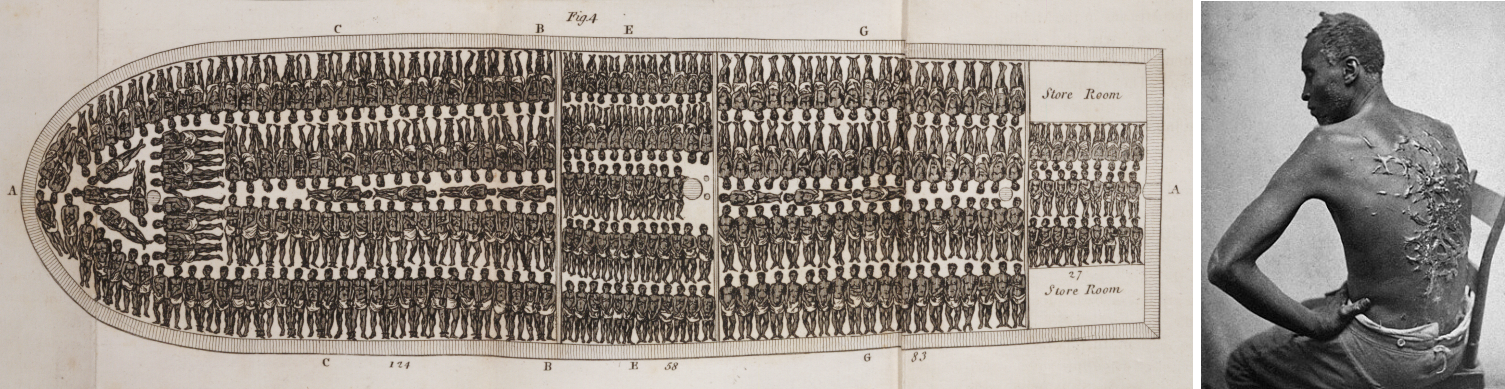
left: One of several lower decks of a slave ship bringing Africans to America in the 1700s.
right: Slave Peter’s scars from many whippings.
The history of America would come to be blemished by post-Atlantean hate directed at Blacks, Native Americans, tyrants, and communists, among many others:
- (1600s-1800s) Euroamericans dragged Black people out of Africa while stripping them of any trace of human dignity and confining them to plantations.
- (1800s) They broke the spirit of Native Americans while taking their beloved lands and dragging them onto reservations, then sent their kids to faraway schools to be Euroamericanized, often brutally.
- (1940s) Americans, by now mostly amalgamated and multiracial, went to war with the Germans and Japanese, who were spreading hate, tyranny, brutality, and death.
- (1950s-70s) They went to war again with the Koreans and Vietnamese, who were spreading communism in their countries… communism and American capitalism being inherently, hatefully incompatible.
Today, all that hate, festering for generations, has inflicted deep emotional wounds in America. Ignoring the wounds or joking about them can keep the hate festering. Constant blaming and lamenting can inflame them. Instead, Americans have to understand and acknowledge the old hatreds until they feel 1) genuine regret for the fact that they (through their ancestors) let it happen, and 2) a deep and complete forgiveness for the brutalities perpetrated on them (through their ancestors). That mutual regret and forgiveness allow multigenerational wounds to heal, as the hate dissipates so that love can grow. But first, they all (or at least those who hope to heal) need a spiritual anchor. They can simply acknowledge the perfect source that shines at the center of everything, and hold it close to the heart, in order to let love start to wash away all the fear and hate stirred up by Earth’s dramas.
In the near future, an autocratic government could conceivably be a good thing for America…
- as long as it lives the ideal dream of love, tolerance, forgiveness, and unity-amid-diversity that have kept America in high regard… or
- unless it follows a path to make America hate again. That would probably bring a quick, violent end to the American dream… and maybe an apocalyptic finish to humanity and the world of this Epoch, which began in Babylon.
When the Consitutional Convention adjourned in 1787, a woman asked Ben Franklin what sort of government they had created for America. Franklin replied, “A republic, if you can keep it.” (Republics and democracies are nations governed collectively by the people rather than by a monarch or dictator.)
# # #


 Macy Afterlife: The Beacon